View of Calcutta From Garden House Reach 17813 Manchester City Art Gallery
| Julia Margaret Cameron | |
|---|---|
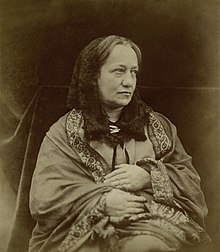 Cameron in 1870 | |
| Born | Julia Margaret Pattle (1815-06-xi)xi June 1815 Calcutta, British India |
| Died | 26 January 1879(1879-01-26) (aged 63) Kalutara, British Ceylon |
| Nationality | British |
| Known for | Photography |
Julia Margaret Cameron (née Pattle; 11 June 1815 – 26 January 1879) was a British photographer who is considered one of the most important portraitists of the 19th century. She is known for her soft-focus close-ups of famous Victorian men and for illustrative images depicting characters from mythology, Christianity, and literature. She as well produced sensitive portraits of women and children.
Later establishing herself outset amid Calcutta'south Anglo-Indian upper-form and then amid London's cultural elite, Cameron formed her own salon frequented past distinguished Victorians at the seaside village of Freshwater, Isle of Wight.
After showing a cracking interest in photography for many years, Cameron took up the practice at the relatively tardily age of 48, later her daughter gave her a photographic camera as a present. She chop-chop produced a large body of piece of work capturing the genius, beauty, and innocence of the men, women, and children who visited her studio at Freshwater, and created unique allegorical images inspired by tableaux vivants, theatre, 15th-century Italian painters, and the work of her creative contemporaries. Her photography career was brusk but productive; she fabricated around 900 photographs over a 12-yr menses.
Cameron's piece of work was contentious in her own fourth dimension. Critics derided her softly focused and unrefined images, and considered her illustrative photographs non-expert and hammy. Even so, her portraits of respected men (such as Henry Taylor, Charles Darwin, and Sir John Herschel) have been consistently praised, both in her own life and in reviews of her work since. Her images have been described as "extraordinarily powerful"[i] and "wholly original",[2] and she has been credited with producing the commencement close-ups in the history of the medium.[ane]
Biography [edit]
Early life and education [edit]
Julia Margaret Cameron was born Julia Margaret Pattle on xi June 1815, at Garden Reach, Calcutta, Republic of india[3] to Adeline Marie (née de l'Etang, 1793–1845) and James Peter Pattle (1775-1845).[4]
James Pattle was a successful official from England who worked in Bharat for the Due east India Company.[3] [five] His family had been involved with the East Bharat Company for many years, though he traced his line to a 17th-century antecedent living in Chancery Lane, London.[half dozen] Her mother was a French blueblood and the daughter of Chevalier Ambrose Pierre Antoine de l'Etang, who had been a page to Marie Antoinette and an officeholder in the Garde du Corps of King Louis XVI.[vii] When he died he was shipped back to London in a butt of rum for burying in Camberwell.
Julia was the fourth of her parents' children. Three of her parents' children[a] died in infancy. Julia and the half-dozen of her six sisters[one] [3] who survived into adulthood[b] had inherited some Bengali blood through their maternal grandmother, Thérèse Josephe Blin de Grincourt. The seven sisters were known for their "charm, wit and beauty" and for being close, outspoken, and unconventional in behaviour and wearing apparel.[8] [c] They favoured Indian silks and shawls rather than the demure Victorian attire of other colonial adult female.[10]
All of the sisters were sent to France every bit children to exist educated, Julia living there with her maternal grandmother in Versaille from 1818 to 1834, after which she returned to India.[i] [three] [5] [11]
Julia'south sisters all made advantageous matches, Adeline marrying a military human who became a General, Sophia marrying a baronet, Louisa, a High Courtroom Judge while Maria married the distinguished Dr John Jackson, with among their descendants beingness Vanessa Bell and Virginia Woolf. Sara married Henry Prinsep an ambassador with the Eastward Republic of india Visitor, and made their home at Trivial Holland Business firm in Kensington, England an important intellectual centre. Among their children was Julia's godchild Julia Stephen. Virginia Pattle married Lord Charles Eastnor, later the third Earl Somers. Their eldest daughter was Lady Isabella Caroline Somers-Cocks, the temperance leader, while the younger, Lady Adeline Marie became the Duchess of Bedford.
Spousal relationship and social life [edit]
South Africa and Calcutta [edit]
In 1835, after suffering several illnesses, Julia visited the Greatcoat of Good Hope in S Africa with her parents to recover.[3] [5] It was common for Europeans living in India to visit South Africa to convalesce after an illness.[1]
While there, she met the British astronomer and photochemist Sir John Herschel, who was observing the southern celestial hemisphere.[eleven] She also met Charles Hay Cameron, 20 years her senior and a reformer of Indian police and education who subsequently invested in coffee plantations in what is now Sri Lanka.[11] Charles Hay was also there to convalesce, likely from a virulent malarial fever which often spread during the Indian monsoon season. The illness he suffered caused recurring kidney trouble and diarrhœa for the balance of his life.[9] : fourteen
They were married in Calcutta on 1 February 1838, two years later on meeting.[1] [3] In Dec of that same year, Julia gave birth to their commencement child; Sir John Herschel was the godfather.[9] : fifteen Between 1839 and 1852, they had vi children, one of whom was adopted.[5] [12] In all, the Camerons raised xi children, five of her ain, five orphaned children of relatives, and an Irish daughter named Mary Ryan whom they found begging on Putney Heath and whom Cameron used as a model in her photographs.[4] [8] [thirteen] Their son, Henry Herschel Hay Cameron, would as well become a photographer.[3]
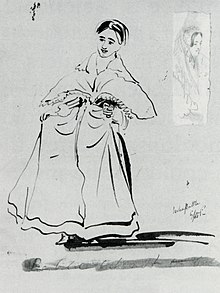
Through the early 1840s—as the organiser of social engagements for the Governor-Full general, Lord Hardinge—Cameron became a prominent hostess in Anglo-Indian gild.[iii] During this time she besides corresponded with Herschel about the latest developments in photographic technology. In 1839, Herschel informed Cameron about the invention of photography.[nine] : 14 [d] In 1842, he sent her two dozen calotypes and daguerreotypes, the first photographs she ever saw.[9] : 42
England [edit]
Perhaps to exist closer to their two children, the Camerons retired to England in 1845, where they took office in London's artistic and cultural scene.[9] : 15 [fourteen] Julia often visited Picayune Kingdom of the netherlands House in Kensington, London, where her sister, Sara Prinsep, oversaw a literary and artistic salon "of Pre-Raphaelite painters, poets, and aristocrats with artistic pretensions".[12] [thirteen] Here, she met many of the well-known subjects of her afterward portraits, including Henry Taylor and Alfred Tennyson.[i]
Daphne du Maurier describes the scene:
The nobilitee, the gentree, the litherathure, polithics and art of the counthree, by jasus! It's a nest of proraphaelites, where Chase, Millais, Rossetti, Watts, Leighton etc, Tennyson, the Brownings and Thackeray etc and tutti quanti receive dinners and incense, and cups of tea handed to them by these women almost kneeling.[15]
Benjamin Jowett echoed this when describing Cameron's reverence to these creative personalities later a afterwards visit to the aforementioned salon-like atmosphere at Freshwater, "She is a sort of hero-worshipper, and the hero is non Mr Tennyson — he simply occupies second identify — but Henry Taylor."[ix] : 27
In 1847, she was writing poesy, had started a novel, and published a translation of Gottfried August Bürger's Leonora.[iii] [12]
In 1848, Charles Cameron retired fully and invested in coffee and rubber plantations in Ceylon, condign i of the island's largest landowners.[9] : 483 The Camerons settled down in England, first in Tunbridge Wells in Kent,[16] where they were neighbours of Taylor,[9] : 16 then to East Sheen in 1850.[3] [v] [9] : 7 During this fourth dimension, Cameron became a member of a society for art didactics and appreciation and George Frederic Watts started working on a painting of Cameron (which is now in the National Portrait Gallery).[9] : 7

Julia Margaret Cameron past George Frederic Watts. Oil on canvas, 1850–1852, 24 in. x xx in. (610 mm ten 508 mm).[17]
In 1860, after an extended visit to Alfred Tennyson at the seaside village of Freshwater, on the Isle of Wight, Cameron hastily purchased a belongings side by side door to Tennyson. The family moved there, naming the holding "Dimbola" afterward one of the coffee plantations in Ceylon.[iii] [xiii] A private gate continued the residences and the 2 families before long started entertaining well-known personalities with music, verse readings, and amateur plays, creating an artistic scene much equally what was previously constitute at Trivial Kingdom of the netherlands House.[1] She lived there until 1875.[18]
Photography career [edit]
Early career [edit]
Cameron showed an interest in photography in the late 1850s and in that location are indications that she experimented with making photographs in the early 1860s.[one] [14] Effectually 1863, her daughter and her son-in-constabulary gave her her commencement photographic camera (a sliding-box camera) as a Christmas present.[v] The souvenir was meant to provide a diversion while her married man was in Ceylon disposed to his java plantations.[14] Of the gift, her daughter stated "It may charm you, Mother, to try to photograph during your confinement at Freshwater."[two]
After receiving the photographic camera, she cleared out a chicken coop and converted it into studio space.[xix] Subsequently, in an unfinished autobiographical manuscript titled Annals of my Glasshouse, Cameron wrote:
I turned my coal-firm into my dark room, and a glazed fowl house I had given my children became my drinking glass house. The hens were liberated, I hope and believe not eaten. The turn a profit of my boys upon new laid eggs was stopped, and all hands and hearts sympathised in my new labour, since the gild of hens and chickens was shortly inverse for that of poets, prophets, painters and lovely maidens, who all in plough take immortalized the humble fiddling subcontract erection.[1] [...] I began with no noesis of the art... I did non know where to place my night box, how to focus my sitter, and my first picture I effaced to my consternation by rubbing my paw over the filmy side of the glass.[2]
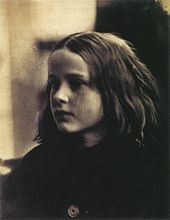
Cameron called this 29 January 1864 portrait of Annie Philpot her "start success."
On 29 Jan 1864 she photographed ix‐year‐old Annie Philpot, an prototype she described as her "get-go success".[1] She sent the photograph to the subject'southward father with the note:
My first perfect success in the consummate Photograph owing greatly to the docility & sweetness of my best & fairest sitter. This Photograph was taken by me at ane p.m. Friday Jan. 29th. Printed—Toned—stock-still and framed all by me & given as it is at present by 8 p.thousand. this aforementioned 24-hour interval.[1]
That aforementioned year, she compiled albums of her images for Watts and Herschel, registered her work and prepared it for exhibition and sale,[9] : 7–8 and was elected to the Photographic Gild of London, of which she remained a member until her death[twenty] and where she displayed work at yearly exhibitions.[three]
Though Cameron took up photography as an amateur and considered herself an artist, and despite never making commissioned portraits nor establishing a commercial studio, she thought of her photographic activeness as a professional endeavour, actively copyrighting, publishing, and marketing her work.[2] Her family did non see substantial profits from their coffee plantations in Ceylon and Cameron may accept been looking to bring in some money with her photography. The portraits of celebrities and the loftier volume of her photographic output also advise commercial aspirations.[9] : 25, 41–42, 496
Mid-career [edit]
In 1865, she became a member of the Photographic Society of Scotland and arranged to have her prints sold through the London dealers P. & D. Colnaghi.[21] She presented a series of photographs, The Fruits of the Spirit, to the British Museum,[9] : 8 and held her first solo exhibition in November 1865.[3] Her prints generated robust demand and she showed her work throughout Europe,[5] securing awards in Berlin in 1865 and 1866,[3] and an honourable mention in Dublin.[ix] : viii
Her photographic activeness was supported by her married man. Cameron wrote: "My married man from start to concluding has watched every picture with please, and information technology is my daily habit to run to him with every glass upon which a fresh glory is newly stamped, and to listen to his enthusiastic applause."[6]
In August 1865, the Due south Kensington Museum, at present the Victoria and Albert Museum, purchased fourscore of her photographs.[ix] : 8 Three years later, the museum offered her two rooms to utilize every bit a portrait studio, essentially making her the museum'southward offset artist-in-residence.[11]

She produced images of Thomas Carlyle and John Herschel in 1867.[3] By 1868, she was generating sales through P. & D. Colnaghi and a 2d London agent, William Spooner. In 1869, she created The Kiss of Peace, which she considered her finest work.[9] : eight

The Kiss of Peace, by Julia Margaret Cameron.
In the early 1870s, Cameron's work matured.[5] Her elaborate illustrative tableauxs involving religious, literary, and classical figures peaked in a series of images for Tennyson's Idylls of the King, published in 1874 and 1875, evidently at her expense.[fourteen] [sixteen] During this time, she besides wrote Annals of my Drinking glass House, an unfinished memoir recounting her photographic career.[9] : 9
Later life [edit]
In October 1873, her daughter died in childbirth. Two years later,[3] considering of her married man's ill health,[sixteen] because of the lower cost of living,[9] : 483 and to be nearer to their sons who were managing the family coffee plantations[11] (which had been badly harmed by a fungus),[9] : 35 Cameron and her husband left Freshwater for Ceylon with "a cow, Cameron'southward photographic equipment, and two coffins, in example such items should not exist available in the East".[ane] [xix]
Henry Taylor recounts the departure:
Mr. and Mrs. Cameron have taken their departure for Ceylon, there to live and die. He had bought an manor there some xxx years ago when he was serving the Crown there and elsewhere in the East, and he had a passionate dearest for the island, to which he had rendered an of import service in providing it with a code of procedure . . . he never ceased to yearn after the isle equally his place of dwelling house, and thither in his eighty-first twelvemonth he has betaken himself, with a strange joy. The design was kept secret, — I believe even from their honey relatives.[9] : 36
5.C. Scott O'Connor after wrote virtually the absence at their vacated home in Freshwater:
The firm is silent now and tenantless. All its erstwhile feverish life and bustle are stilled every bit is the heart which trounce here in true sympathy with every living creature that came within its reach needing such succor. Her pretty maids, her scholars, her poets, her philosophers, astronomers, and divines, all those men of genius who came and sabbatum willingly to her while in a fever of creative emotion she plied the instruments of her art, — they have all gone, and silence is the just tenant left at Dimbola.[9] : 37
The movement effectively marked the end of Cameron'southward photography career;[iii] she took few photographs afterwards,[16] generally of Tamil servants and workers.[east] [nine] : ix Fewer than 30 images survive from this period. Cameron's output may have dropped in part because of the difficulty working with collodion in the insect-friendly oestrus where fresh water was less available for washing prints.[9] : 483 The botanical painter and biologist Marianne North recounted her fourth dimension visiting Cameron In Ceylon:
The walls of the room were covered with magnificent photographs; others were tumbling about the tables, chairs, and floors with quantities of clammy books, all untidy and picturesque; the lady herself with a lace veil on her head and flowing draperies. Her oddities were most refreshing . . . She too fabricated some studies of natives while I was there, and took such a fancy to the back of one of them (which she said was absolutely superb) that she insisted on her son retaining him as her gardener, though she had no garden and he did not know even the significant of the discussion.[9] : 483 [13]
In Feb 1876, Macmillan's Magazine published her poem, On a Portrait. The following year, her image The Parting of Sir Lancelot and Queen Guinevere appeared on the cover Harper's Weekly equally a wood engraving.[9] : 9
After a short visit to England six months earlier, Cameron fell ill with a dangerous chill[v] and died on 26 Jan 1879[11] at the Glencairn manor in Ceylon.[3] It is often reported that her final word was "Dazzler"[ane] [14] or "Cute".[19]
In her 12-twelvemonth career, Cameron produced around 900 photographs.[2]
Photographic piece of work [edit]
Influences [edit]
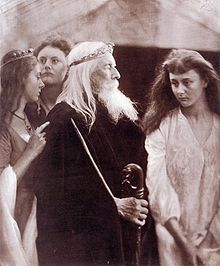
King Lear allotting his Kingdom to his 3 daughters. Sitters are Lorina Liddell, Edith Liddell, Charles Hay Cameron and Alice Liddell.
Cameron was an educated and cultured woman; she was a Christian thinker familiar with medieval art, the Renaissance, and the Pre-Raphaelites.[f] [6] She may also have been influenced past the gimmicky involvement in phrenology, the written report of the human physiognomy as a sign of a person's character.[one] The One-time Masters also informed her work. Her compositions and use of light have been connected to Raphael, Rembrandt, and Titian.[3]
John Herschel, who relayed to Cameron the news of the inventions of photography by Talbot and Daguerre,[9] : 42 was an important influence on technique and the practicalities of the medium, as indicated in a letter Cameron wrote to the astronomer, "You were my first instructor and to you I owe all the first experience and insights."[viii]
It is likely that Cameron saw Reginald Southey photographing on the Island of Wight during a vacation in 1857 when he visited the Camerons and photographed their children and the children of her neighbour, Alfred Tennyson, before Cameron took up the medium in earnest.[9] : 42
Perhaps the nearly of import photographer to influence Cameron'south work was David Wilkie Wynfield. Cameron'southward style of close-upwardly portraits resembling Titian may well have been learned from Wynfield, since she took a lesson from him and afterward wrote "I consult him in correspondence whenever I am in difficulty".[8] Much like Cameron, Wynfield published an album of soft-focus portraits of friends dressed up as characters from history or literature.[13] The press compared their photographic work and noted the similarities in style and their consideration of the medium every bit fine fine art.[9] : 46 She afterwards wrote that "to my feeling about his beautiful photography I owed all my attempts and indeed consequently all my success".[22]
Concept of genius and beauty [edit]
Cameron'south portraits are partly the production of her intimacy and regard for the subject, merely also intend to capture "item qualities or essences—typically, genius in men and beauty in women".[three] Mike Weaver, a scholar who wrote about Cameron's photography in piece of work published in 1984, framed her idea of genius and dazzler "inside a specifically Christian framework, as indicative of the sublime and the sacred".[iii] Weaver supposes that Cameron'south myriad influences informed her concept of dazzler: "the Bible, classical mythology, Shakespeare's plays, and Tennyson'southward poems were fused into a single vision of ideal beauty."[6]
Cameron herself indicated her desire to capture beauty. She wrote, "I longed to arrest all the beauty that came earlier me and at length the longing has been satisfied"[ix] : 175 [23] and "My aspirations are to ennoble Photography and to secure for it the grapheme and uses of Loftier Art by combining the real & Ideal & sacrificing nothing of Truth by all possible devotion to verse and dazzler."[11]
Her female subjects were typically chosen for their dazzler,[24] particularly the "long-necked, long-haired, immature beauty familiar in Pre-Raphaelite paintings".[1] In Virginia Woolf's farcical play Freshwater, which described the cultural scene at Freshwater, Cameron'due south character comically expresses her commitment to dazzler:
I take sought the cute in the most unlikely places. I accept searched the law at Freshwater, and not a man take I found with calves worthy of Sir Galahad. But, as I said to the Principal Lawman, "Without beauty, constable, what is social club? Without life, what is law?" Why should I go along to have my argent protected by a race of men whose legs are aesthetically abhorrent to me? If a burgler came and he were cute, I should say to him: Accept my fish knives! Take my cruets, my bread baskets and my soup tureens. What you take is nothing to what you give, your calves, your beautiful calves.[6]
Portraits [edit]
Cameron's photographs are more often than not placed into three categories: distinguished portraits of men, delicate portraits of women, and illustrative allegories based on religious and literary works.[25]
Men [edit]
Cameron'south portraits of men were a kind of hero-worship.[ix] : 175 To Thomas Carlyle, Cameron wrote "When I have had such men earlier my camera my whole soul has endeavoured to do its duty towards them in recording faithfully the greatness of the inner as well equally the features of the outer man. The photo thus taken has been well-nigh the embodiment of a prayer."[8]
Most of these men are well-known scientists, writers, or clergymen of the Victorian era.[9] : 291 Cameron turned to Old Main paintings and the contemporary idea — based in phrenology — of the ideal "type" to capture the greatness that she perceived in these eminent Victorian individuals.[12] Her aspiration to record this greatness resulted in powerful images displaying a masterly command of chiaroscuro that resulted in "the finest and near revealing gallery of eminent Victorians in existence".[9] : 292
Janet Malcom notes the attention Cameron paid to hair every bit an expressive element in her portraits, writing that "Her closeups of Tennyson, Carlyle, Darwin, Longfellow, Taylor, Watts, and Charles Cameron are every bit much celebrations of beards every bit of Victorian eminence."[6]
-

Charles Darwin
-

Henry Taylor
-

Women [edit]
Her images of women are decidedly softer than those of men. With less dramatic lighting and a more than typical altitude between the sitter and the camera, these images are less dynamic and more than conventional than her images of men.[9] : 175
Cameron almost exclusively photographed younger women, never making a portrait even of her neighbour and skillful friend Emily Tennyson.[ix] : 26 According to a biographer of Charles Darwin, Cameron refused to have a picture of Darwin's wife, proverb that "no adult female must exist photographed between the ages of xviii and seventy."[half-dozen]
Her mature photographs of women are noted for their subtle but suggestive representation of the obscurity and malleability of female identity. Many of her images of young women obscure their individuality and represent their identity as multifaceted and changeable[nine] : 68 by showing them "in pairs, or reflected in a mirror... ofttimes expressive of a deep ambiguity and anxiety."[3]
Janet Malcolm again notes Cameron's attending to the hair of her subjects, writing that "Like the fiddling girls whose hair was mussed to rid it of its prim nursery look, the bigger girls were made to undo their buns and chignons so that their hair would poetically stream or flow or twist around their faces".[6]
-

-

-

Julia Jackson
-

Suspense
Children [edit]
Children — her own children, those of relatives, and young locals — were frequently models for Cameron. Children were popular subjects in the Victorian era and Cameron kept with the prevailing notion of them equally innocent, kind, and noble. She regularly depicted them as angels or as children from Bible stories.[nine] : 373
The children in her images were non always cooperative, and her attempts to cast them as allegorical figures were often frustrated past the children's boredom, indignation, distraction — moods which are often evidenced in her images.[nine] : 374
-
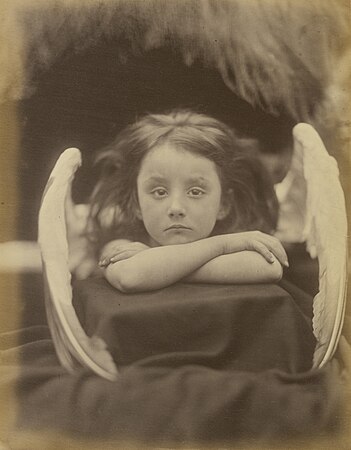
I Wait
-

Angel of the Birth
-
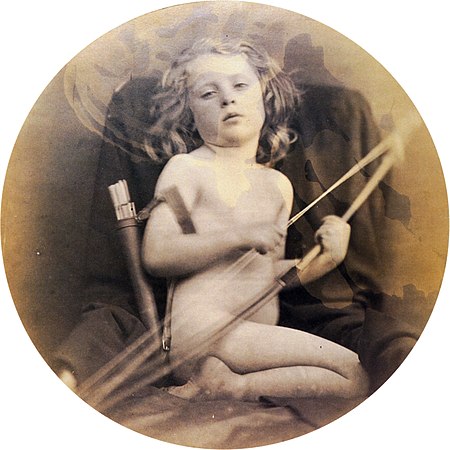
Love in Idleness
-
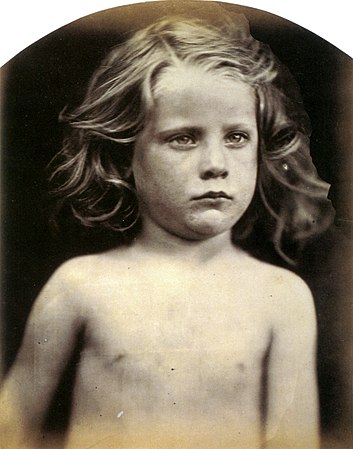
Young Astyanax
-

Allegories and illustrations [edit]
Cameron may have found these illustrative group portraits more than challenging than her other images. With more people in the image, the chances were greater that someone would move during the long exposures, and so more calorie-free was needed to shorten the exposure time and abort the motion. More sitters too meant a greater depth of field was necessary to put anybody in focus, further complicating the compositions.[nine] : 433
Cameron's narrative portraits of women were influenced by tableaux vivants and amateur theatre. The women in her images are typically depicted in the idealised Victorian roles of mother and wife.[12]
Religion [edit]
Cameron made over 50 images representing the Madonna, oftentimes played by her household servant Mary Hillier. These images present "an ideal of femininity that combines wholesomeness with qualities of sensuality and vulnerability". She represented the Virgin Mary in various scenes from the Bible, such as the Annunciation and the Salutation,[9] : 130 but also created a number of images illustrating more obscure religious figures.[9] : 129
-
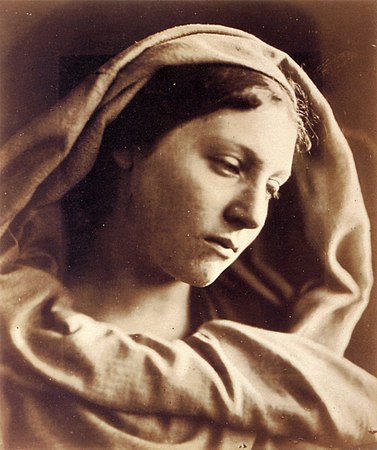
Mary Mother
-

The Affections at the Tomb
Literature [edit]
Cameron took literature every bit inspiration for her illustrative photographs, representing characters from Shakespeare, Elizabethan poems, novels, plays, and the work of her contemporaries: Alfred Tennyson, Henry Taylor, Christina Rossetti, Robert Browning, and George Eliot.[9] : 434
-

Maud "There has Fallen a splendid Tear From the Passion Flower at the Gate", 1875
-

"He idea of that precipitous wait Mother I gave him yesterday"/"They call me roughshod hearted, I care not what they say", 1875
-

Queen Esther before King Ahasuerus, 1865
-
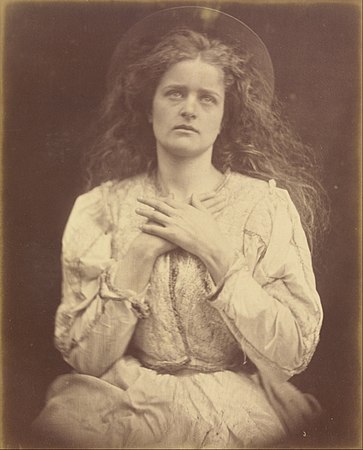
"So now I think my time is near – I trust it is – I know"/"The blessed Music went that way my soul will have to go", 1875
Idylls of the King [edit]
In 1874, Alfred Tennyson asked Cameron to create illustrations for a new edition of his Idylls of the King, a popular series of poems about Arthurian legends.[9] : 434 Cameron worked on this commission for three months, capturing several images in her notable soft focus way. She was unhappy with the terminal publication, and complained that the pocket-size size of her images depleted their significance. This prompted Cameron to effect a palatial version of the Idylls of the King which featured a series of twelve photographs as full-size prints.[26] This series of images, influenced in function by Watts,[19] was her last large-calibration project[xvi] and is considered the height of her illustrative work.[one] [xiv]
-

Departing of Sir Lancelot and Queen Guinevere 1874
-
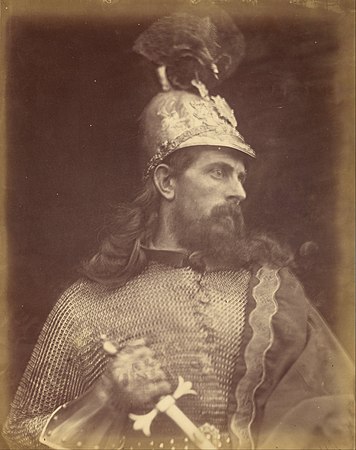
Rex Arthur
Reception and legacy [edit]
Contemporary reception [edit]
In her ain time, Cameron's photographs establish a contentious audience, with many criticising her utilize of soft focus and her unretouched prints.[3]
In 1865, The Photographic Journal reviewed her images, commenting:
Mrs. Cameron exhibits her serial of out-of-focus portraits of celebrities. Nosotros must give this lady credit for daring originality, only at the expense of all other photographic qualities. A true artist would apply all the resources at his disposal, in whatever branch of art he might practise. In these pictures, all that is good in photography has been neglected and the shortcomings of the art are prominently exhibited. Nosotros are sorry to accept to speak thus severely on the works of a lady, but we feel compelled to do and so in the interest of the fine art.[2]
The Photographic News echoed this sentiment:
What in the name of all the nitrate of argent that always turned white into black have these pictures in common with good photography? Smudged, torn, dingy, undefined, and in some cases about unreadable, there is inappreciably 1 of them that ought not to have been done off the plate as before long as information technology appeared We cannot but think that this lady's highly imaginative and creative efforts might be supplemented by the judicious employment of a modest male child with a wash leather, and a lens screwed a trifle less out of accurate definition.[9] : 54
The Illustrated London News provided an alternative perspective, writing that her images were "the nearest approach to art, or rather the most assuming and successful applications of the principles of fine-fine art to photography".[2]
Early impact [edit]
Cameron's niece Julia Prinsep Stephen (née Jackson; 1846–1895) wrote a biography of Cameron that appeared in the first edition of the Dictionary of National Biography, 1886.[27]
A few years subsequently, George Bernard Shaw reviewed a posthumous exhibition of Cameron's, writing:
While the portraits of Herschel, Tennyson and Carlyle beat hollow anything I have e'er seen, right on the same wall, and virtually in the same frame, at that place are photographs of children with no clothes on, or else the underclothes by way of propriety, with palpably newspaper wings, nigh inartistically grouped and artlessly labelled as angels, saints or fairies. No-one would imagine that the artist who produced the marvellous Carlyle would have produced such childish trivialities.[9] : 433
Virginia Woolf wrote a comic portrayal of the "Freshwater circle" in her only play Freshwater. Later, in collaboration with Roger Fry, Woolf as well edited the outset major collection of Cameron's photographs, Victorian Photographs of Famous Men and Off-white Women, published in 1926.[3] [28] In the introduction to this drove, Fry wrote that Cameron's emblematic photographs "must all exist judged as failures from an aesthetic viewpoint".[9] : 433 He was more charitable toward her other piece of work, writing that she had "a wonderful perception of character equally it is expressed in course" and that her work was superior to the portraits of James Abbott McNeill Whistler and George Frederic Watts.[9] : 291
Despite the publication of this collection, Cameron'southward piece of work remained obscure until the mid-1940s.
Mid-century rediscovery [edit]
Helmut Gernsheim, subsequently seeing photographs that Cameron had donated to a railway station in Hampshire hanging in the waiting room of the station, published a volume on her work that helped establish her reputation.[iii] [29] Gernsheim'southward review of Cameron's piece of work echoed the earlier sentiments of George Bernard Shaw and Roger Fry, criticising her allegorical and illustrative photos while praising her more straightforward portraits:
If the majority of Mrs. Cameron'south discipline pictures seem to u.s. affected, ludicrous and amateurish, and appear in our opinion to be failures, how masterly, on the other hand, are her straightforward, truthful portraits, which are entirely gratis from false sentiment, and which recoup for the errors of sense of taste in her studies.[six]
In 1984, Mike Weaver disputed this analysis in his book Julia Margaret Cameron 1815–1879, where he elevated Cameron'southward tableauxs equally sincere religious interpretations. Weaver as well criticised the characterisations of Cameron's personality that focused on her supposed eccentricities.[half-dozen]
21st century reception [edit]
Colin Ford, in the Encyclopedia of Nineteenth-Century Photography calls her images "extraordinarily powerful" and "arguably the offset 'close-upward' photographs in history".[ane] He continues:
Her visualisations of poesy are different in style and achievement from those of any other photographer of the time. Her contemporaries decorated books of poetry by Burns, Gray, Milton, Scott, Shakespeare and others with picturesque landscapes, occasionally peopling these with attractively disposed figures in the scenery, only rarely illustrating actual characters or incidents from the story.[i]
For the Metropolitan Museum of Art's Heilbrunn Timeline of Art History, Malcolm Daniel writes:
Her artistic goals for photography, informed past the outward appearance and spiritual content of fifteenth-century Italian painting, were wholly original in her medium. She aimed for neither the finish and formalized poses common in the commercial portrait studios, nor for the elaborate narratives of other Victorian "high art" photographers such as H. P. Robinson and O. Thou. Rejlander.[2]
Janet Malcolm, in "The Genius of the Drinking glass House" writes that "Cameron's compositions have more than connection to the family album pictures of recalcitrant relatives who have been herded together for the obligatory group picture than they practice to the masterpieces of Western painting" only that "The beauty that Cameron found, and in a surprising number of cases was able to abort, among the aging and anile men of the Victorian literary and fine art establishment is a cornerstone of her accomplishment".[half dozen] In 2003, the J. Paul Getty Museum published a complete catalogue of Cameron'southward known surviving photographs. I caption of a portrait of Alice Liddell (whom Cameron photographed equally Alethea, Pomona, Ceres, and St. Agnes in 1872) claims that "Cameron's photographic portraits are considered among the finest in the early history of photography".[xxx]

In 2018, The Norman Anthology was deemed by the Reviewing Commission on the Export of Works of Art to be of "outstanding aesthetic importance and significance to the study of the history of photography and, in particular, the work of Julia Margaret Cameron—one of the most meaning photographers of the 19th century."[31]
Retrospectives [edit]
In 2013, the Metropolitan Museum of Art curated an exhibition of Cameron's work, which garnered meaning reviews.[32]
In 2022 the Victoria and Albert Museum in London drew on their extensive collection of her piece of work for a 200th anniversary retrospective of Cameron's career that as well travelled to Sydney, Commonwealth of australia.
An exhibition at the National Portrait Gallery in London in March 2022 placed her piece of work in human relationship to the work of her Victorian contemporaries, Lady Clementina Hawarden, Oscar Rejlander, and Lewis Carroll.[33]
The following retrospective exhibitions take focused on Cameron's oeuvre:
| Title | Dates | Institution | Country |
|---|---|---|---|
| Julia Margaret Cameron | 16 Dec 1960 – 31 January 1961 | Limelight Gallery | United States |
| Mrs. Cameron'southward photographs from the life [34] | 22 January 1974 – 10 March 1974 | Stanford University Museum of Art | The states |
| Whisper of the Muse [35] | ten September 1986 – 16 November 1986 | Getty Villa | U.s.a. |
| Whisper of the Muse at Loyola Marymount University [36] | 12 September 1986 – 25 Oct 1986 | Laband Gallery | United states of america |
| Portrait Photographs by Julia Margaret Cameron [36] | 25 November 1987 – 14 February 1988 | National Portrait Gallery | Us |
| Julia Margaret Cameron: The Creative Process [36] | 15 Oct 1996 – v January 1997 | Getty Villa | Us |
| four February 1998 – 3 May 1998 | Art Gallery of Ontario | Canada | |
| Julia Margaret Cameron: Nineteenth Century Photographic Genius [36] | six February 2003 – 26 May 2003 | National Portrait Gallery, London | United Kingdom |
| 5 June 2003 – thirty August 2003 | National Media Museum | United Kingdom | |
| Julia Margaret Cameron, Photographer [37] | 21 Oct 2003 – 11 January 2004 | Getty Middle | United States |
| Julia Margaret Cameron [38] | xix August 2013 – 5 January 2014 | Metropolitan Museum of Art | United States |
| Julia Margaret Cameron [39] | 15 August 2022 – 25 October 2015 | Art Gallery of New South Wales | Australia |
| Julia Margaret Cameron: Influence and Intimacy [40] | 24 September 2022 – 28 March 2016 | Science Museum, London | United Kingdom |
| Julia Margaret Cameron [41] | 28 November 2022 – 21 February 2016 | Victoria and Albert Museum | United kingdom |
| Julia Margaret Cameron: A Woman who Breathed Life into Photographs [42] | 2 July 2022 – xix September 2016 | Mitsubishi Ichigokan Museum | Nihon |
Albums [edit]
| Title | Dedication appointment |
|---|---|
| Mia Album | 7 July 1863 |
| Watts Album | 22 February 1864 |
| Herschel Album | 26 November 1864[g] |
| Overstone Album | v August 1865 |
| Lindsay Album | – |
| Thackeray Album | 1864[h] |
| Henry Taylor Album | –[i] |
| Norman Album | vii September 1869 |
| Aubrey Ashworth Taylor Anthology | 29 September 1869 |
List of selected publications [edit]
- Cameron, Julia Margaret (1973) [1926]. Victorian photographs of famous men & fair women. Introductions by Virginia Woolf and Roger Fry. D. R. Godine. ISBN978-0-87923-076-0.
- Cameron, J. Thousand. P. (1875). Illustrations by Julia Margaret Cameron of Alfred Tennyson'due south Idylls of the Rex and other poems
- Cameron, J. G. P. (1889). Unfinished autobiography "Annals of my glass house" by Julia Margaret Cameron, written 1874, first published 1889
- Cameron, J. Thousand. (1975). The Herschel album: an album of photographs. London (two St Martin'southward Identify, WC2H 0HE): National Portrait Gallery
- Cameron, J. K., & Ford, C. (1975). The Cameron Collection: an album of photographs. Wokingham: Van Nostrand Reinhold for the National Portrait Gallery
- Cameron, J. M. P., & Weaver, M. (1986). Whisper of the muse: the Overstone album & other photographs. Malibu: J. Paul Getty Museum
Footnotes [edit]
- ^ James (1813–1813), Eliza (1814-1818) and Harriet (1828–1828)
- ^ Adeline (1812-1836), Sara (1816-1887), Maria (1818-1892), Louisa (1821-1873), Virginia (1827-1910) and Sophia (1829-1911)
- ^ All of the sisters spoke Hindustani and French[nine] : 12
- ^ Herschel coined the terms "photography," "snapshot," and "negative."[13]
- ^ Cameron described these subjects as "natives", much as she referred to the residents of the Isle of Wight as "peasants".[1]
- ^ Of the Pre-Raphaelites, "she was closest in her artistic ethics and the ethos of her piece of work to G. F. Watts".[3]
- ^ According to Cameron'due south dedication, on September 8, 1867 the anthology was "completed & restored with renewed / devotedness of grateful friendship".
- ^ The dedication specifies that the album was "Commenced year 1864".
- ^ This album contains no dedication.
References [edit]
- ^ a b c d e f g h i j thou l k north o p q r s t Ford, Colin (2008). "Cameron, Julia Margaret, 1815–1879". In Hannavy, John (ed.). Encyclopedia of Nineteenth-Century Photography. London, UK: Routledge. Retrieved 28 April 2019.
- ^ a b c d e f g h Daniel, Malcolm. "Julia Margaret Cameron (1815–1879)". The Met'southward Heilbrunn Timeline of Art History . Retrieved four May 2019.
- ^ a b c d e f g h i j k l thou n o p q r s t u v westward x y z Barlow, Helen (2017). "Cameron [née Pattle], Julia Margaret (1815–1879), lensman". Oxford Dictionary of National Biography. Oxford Lexicon of National Biography (online ed.). Oxford Academy Printing. doi:x.1093/ref:odnb/4449. (Subscription or UK public library membership required.)
- ^ a b "Family Tree & Genealogy Tools for Julia Margaret (Pattle) Cameron". WikiTree. Retrieved v Baronial 2021.
- ^ a b c d e f one thousand h i "Julia Margaret Cameron". The Fine art Story. 7 August 2018. Retrieved three May 2019.
- ^ a b c d e f g h i j k Malcolm, Janet (4 Feb 1999). "The Genius of the Glass House". The New York Review of Books. ISSN 0028-7504. Retrieved v May 2019.
- ^ Boatright, Robert Chiliad.; Southworth, Helen (2004). The Intersecting Realities and Fictions of Virginia Woolf and Colette – Helen Southworth. ISBN9780814209646.
- ^ a b c d due east Higgins, Charlotte (22 September 2015). "Julia Margaret Cameron: soft-focus lensman with an iron will". The Guardian. ISSN 0261-3077. Retrieved 3 May 2019.
- ^ a b c d e f m h i j k l thou north o p q r southward t u v westward 10 y z aa ab air conditioning advert ae af ag ah ai aj ak al am an ao ap aq ar every bit at au Cox, Julian; Ford, Colin (2003). Julia Margaret Cameron: The Complete Photographs . Los Angeles, CA: Getty Publications. ISBN0-89236-681-viii.
- ^ Schama, Simon (2011). A History of Britain: The Fate of Empire 1776-2000 (Paperback). London: The Bodley Caput. pp. 178–181. ISBN9781847920140.
- ^ a b c d eastward f m Weiss, Marta. "Julia Margaret Cameron – an introduction". Victoria and Albert Museum . Retrieved 30 April 2019.
- ^ a b c d eastward Lukitsh, Joanne (2018). "Cameron [Pattle], Julia Margaret". Grove Art Online. doi:10.1093/gao/9781884446054.article.T013434. ISBN978-1-884446-05-4.
- ^ a b c d eastward f Thurman, Judith (10 Feb 2003). "Angels and Instincts". The New Yorker. ISSN 0028-792X. Retrieved 30 April 2019.
- ^ a b c d eastward f Ford, Colin (2005). "Cameron, Julia Margaret". The Oxford Companion to the Photograph . Oxford University Printing. ISBN978-0-19-866271-6 . Retrieved 28 April 2019.
- ^ Daphne Du Maurier, ed., The Young George Du Maurier: A Option of His Letters, 1860–67 (Garden Urban center, Due north.Y.: Doubleday, 1952), p. 112, quoted in Leonee Ormond, George Du Maurier (London: Routledge and Kegan Paul, 1969), p. 103, quoted in Cox, Julian; Ford, Colin (2003). Julia Margaret Cameron: The Complete Photographs . Los Angeles, CA: Getty Publications. ISBN0-89236-681-8.
- ^ a b c d e "Julia Margaret Cameron". National Gallery of Art . Retrieved 3 May 2019.
- ^ "NPG 5046; Julia Margaret Cameron – Portrait Extended". National Portrait Gallery . Retrieved eight May 2019.
- ^ Birch, Dinah (ane January 2009). "Cameron, Julia Margaret". In Dinah Birch (ed.). The Oxford Companion to English language Literature. Oxford University Press. ISBN978-0-nineteen-280687-one . Retrieved 28 Apr 2019.
- ^ a b c d "Julia Margaret Cameron". Britannica Academic . Retrieved 28 Apr 2019.
- ^ "Members of the Imperial Photographic Society, 1853–1901". The Royal Photographic Society. 2013. Retrieved 27 October 2015.
- ^ "Julia Margaret Cameron". International Center of Photography. 31 Jan 2018. Retrieved 3 May 2019.
- ^ "Julia Margaret Cameron: Related Photographers". Victoria and Albert Museum. 2016. Retrieved 25 March 2018.
- ^ AskOxford: The Cod and the Camera Quote is taken from her unpublished autobiography, "Annals of My Glass Business firm."
- ^ Ford, Colin (2005). "Cameron, Julia Margaret". The Oxford Companion to the Photograph . Oxford University Press. ISBN978-0-nineteen-866271-6 . Retrieved 28 Apr 2019.
- ^ Rosenblum, Naomi. A History of Women Photographers. Tertiary ed. New York: Abbeville Press Publishers, 2010. p. 52.
- ^ Rosen, Jeff (2016). Julia Margaret Cameron'southward 'fancy subjects': photographic allegories of Victorian identity and empire. Manchester: Manchester University Press. pp. 233–234. ISBN9781784997465.
- ^ Stephen, Fifty. (1886). Lexicon of national biography: vol. Viii. Burton – Cantwell. London: Smith, Elder, & Co.
- ^ Woolf, V., & Fry, R. E. (1926). Victorian photographs of famous men & women. New York: Harcourt, Brace.
- ^ Gernsheim, H. (1948). Julia Margaret Cameron; her life and photographic work. Famous photographers. London: Fountain Press; distributed in the United states by Transatlantic Arts, New York.
- ^ "Photograph past Julia Margaret Cameron of Alice Liddell: Getty Images #90762993". Getty Images. Retrieved v March 2013.
- ^ "Famed photography anthology at risk of leaving the UK". Government of the U.k.. Retrieved 9 February 2018.
- ^ Lane, Anthony, Names and Faces, the portraits of Julia Margaret Cameron, The New Yorker, 2 September 2013, pages 69–73.
- ^ "Victorian Giants: The Birth of Art Photography ane March – 20 May 2018" (Museum exhibition). National Portrait Gallery, London. Retrieved 26 March 2018.
- ^ Mozley, Anita Ventura (1974). "Mrs. Cameron's photographs from the life" : [exhibition] 22 Jan-10 March 1974. Palo Alto, California: Department of Art, Stanford Academy. OCLC 33005764.
- ^ Cameron, Julia Margaret; Howard, Jeremy (1990). Whisper of the muse : the world of Julia Margaret Cameron. London: Colnaghi. ISBN978-0-89236-088-8.
- ^ a b c d "The Whisper of the Muse / Portrait of G.F. Watts". The J. Paul Getty Museum . Retrieved 29 Nov 2015.
- ^ "Julia Margaret Cameron, Lensman". The J. Paul Getty Museum . Retrieved 29 Nov 2015.
- ^ "Julia Margaret Cameron". The Metropolitan Museum of Art . Retrieved 29 November 2015.
- ^ "Julia Margaret Cameron". Art Gallery of New South Wales . Retrieved 29 November 2015.
- ^ "Julia Margaret Cameron: Influence and Intimacy". Science Museum . Retrieved 29 November 2015.
- ^ "Julia Margaret Cameron". Victoria and Albert Museum . Retrieved 29 Nov 2015.
- ^ "Julia Margaret Cameron: A Woman who Breathed Life into Photographs". Mitsubishi Ichigokan Museum . Retrieved 25 March 2018.
Farther reading [edit]
- Ford, Colin (2003). Julia Margaret Cameron: A Critical Biography. Getty Publications. ISBN978-0-89236-707-8.
- Douglas-Fairhurst, Robert (Jan 2016). "The Taker of Chances". Apollo. 183 (638): 48–54.
- Lukitsh, Joanne (2006). Julia Margaret Cameron. Phaidon. ISBN9780714846187.
- Olsen, Victoria (2003). From Life: Julia Margaret Cameron & Victorian Photography. Palgrave Macmillan. ISBN978-i-4039-6019-1.
- Nordstrom, Alison Devine (i April 2001). "Julia Margaret Cameron's Women (review)". Victorian Studies. 43 (3): 499–501. doi:10.1353/vic.2001.0072. ISSN 1527-2052. S2CID 144738863.
- Rosen, Jeff (2016). Julia Margaret Cameron's 'Fancy Subjects' Manchester Academy Press
- Wolf, Sylvia, ed. (1998). Julia Margaret Cameron's Women. Art Institute of Chicago. ISBN978-0-300-07781-0. likewise available through MOMA here
External links [edit]
- Julia Margaret Cameron at The Museum of Modern Art
- Julia Margaret Cameron at The J. Paul Getty Museum
- Julia Margaret Cameron family unit papers, circa 1777-1940 at the Getty Research Institute, Los Angeles, Accession No. 850858.
- Julia Margaret Cameron at the National Portrait Gallery
- Julia Margaret Cameron at the National Gallery of Art
- Julia Margaret Cameron at the Art Institute of Chicago
- Julia Margaret Cameron at the National Galleries of Scotland
- Alfred Tennyson's Idylls of the Male monarch, illustrated past Julia Margaret Cameron
Source: https://en.wikipedia.org/wiki/Julia_Margaret_Cameron
0 Response to "View of Calcutta From Garden House Reach 17813 Manchester City Art Gallery"
Post a Comment